
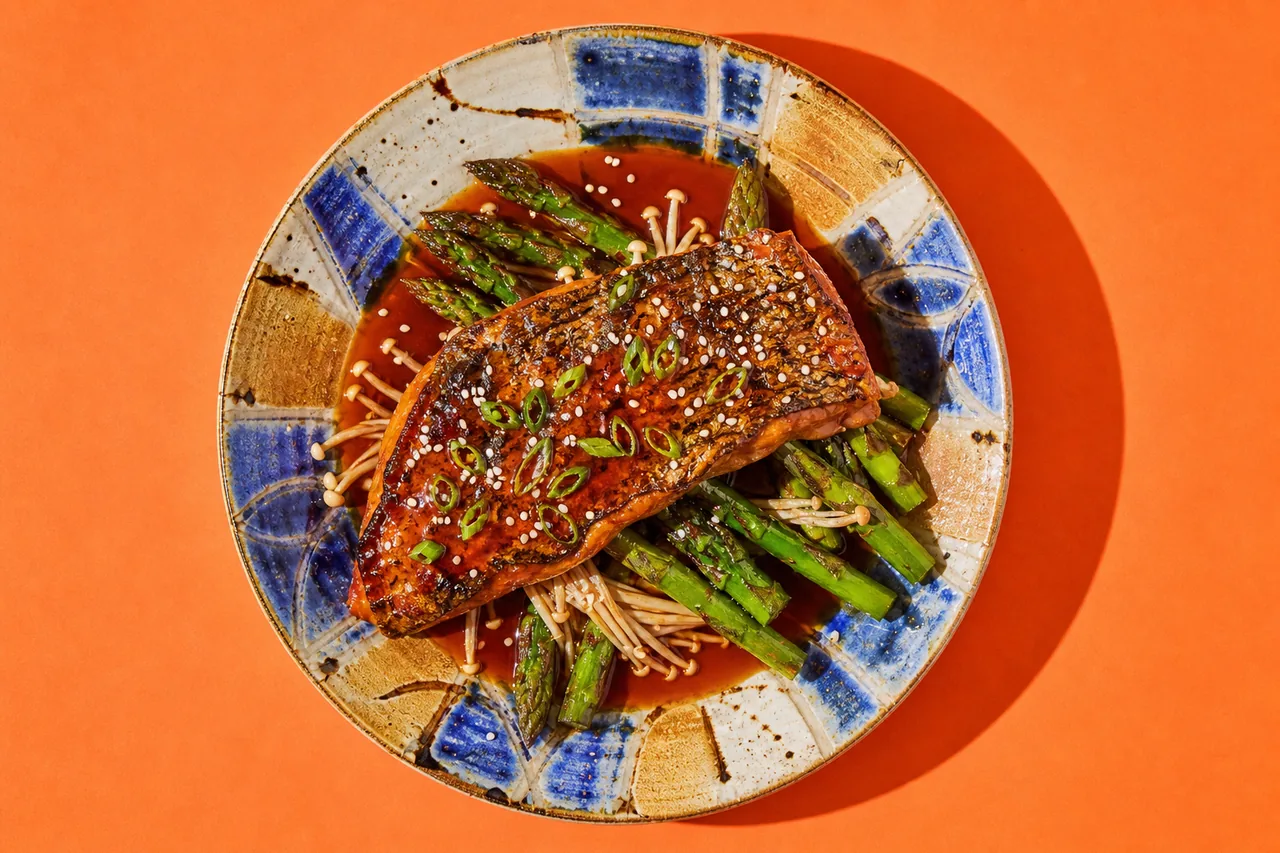
A global seafood creation where asp, a delicate and firm freshwater fish, is seared like a prime cut and finished with a bulgogi-style pear glaze. Reduced gochujang broth lends depth, asparagus stays crisp-tender, and enoki mushrooms add a delicate touch without overpowering the fish.
Ingredients
- 360 g fresh asp fillets with skin, pin-boned by the fishmonger
- 250 g fresh green asparagus
- 400 ml low-sodium chicken broth or vegetable broth
- 35 g Korean gochujang chili paste
- 1 piece ripe but firm pear
- 80 g fresh enoki mushrooms
- 2 pieces fresh scallions
- 25 ml light soy sauce
- 2 tsp toasted sesame oil
- 1 tbsp rice vinegar
- 1 tsp liquid honey
- 1 clove fresh garlic
- 10 g fresh ginger
- 1 tsp white sesame seeds
- 2 tbsp canola oil
- to taste fine salt
Method
- Prepare the fish: pat the asp fillets thoroughly dry with paper towels, check for any remaining bones with your fingertips, and lightly season the flesh side with salt. Let rest in the refrigerator for 15 minutes at 4 °C to firm up the flesh; the surface should become matte and satin-smooth.
- Make the bulgogi base: finely grate the pear, catching all of its juice. Grate the garlic and ginger, then combine them in a bowl with the gochujang, soy sauce, rice vinegar, honey, and part of the toasted sesame oil. The mixture should be smooth, pourable, and a glossy brick-red color.
- Build the bulgogi broth: pour the broth into a small saucepan, whisk in the bulgogi base, and bring to a gentle simmer around 85 °C to 90 °C. Simmer uncovered for 10 minutes, stirring regularly, until the liquid lightly coats the back of a spoon and reduces by one-third. Cover and keep warm over very low heat (about 65 °C).
- Briefly marinate the asp: generously brush the flesh side of the fillets with a little of the warm reduced bulgogi broth, leaving the skin untouched so it stays dry. Let rest at room temperature for exactly 5 minutes, just until the flesh takes on a light amber sheen.
- Prep the vegetables: snap off the woody ends of the asparagus spears, pull the enoki mushrooms apart into small, even clusters, and thinly slice the scallions on a bias about 2 mm thick.
- Roast the asparagus: heat a skillet with a drizzle of canola oil over medium-high heat (around 180 °C). Add the asparagus and roll the spears in the pan for 6 to 7 minutes: they should turn bright green, blister with small brown spots over 20 to 30 % of their surface, and remain crisp-tender when pierced with a knife tip. Transfer to a plate and keep warm.
- Saute the enoki: in the same hot skillet (around 170 °C), add the enoki mushrooms and saute briskly for 1 minute to 1 minute 30. As soon as they soften and take on light golden color without releasing excess water, remove from the heat and finish with a drizzle of toasted sesame oil.
- Sear the asp skin-side down: heat a nonstick skillet with a drizzle of canola oil over medium-high heat until it reaches 180 °C. Lay the fillets in skin-side down, press firmly with a flat spatula for 30 seconds to prevent curling, and let crisp untouched for 3 minutes until the skin is deep golden brown and the flesh turns opaque two-thirds of the way up.
- Glaze the fish: reduce the heat to low (around 140 °C), flip the fillets flesh-side down for 1 minute of cooking, then spoon several tablespoons of the reduced bulgogi broth into the skillet. Baste the flesh continuously for an additional 1 minute until a syrupy glaze coats the fish and the internal temperature reaches 48 °C to 50 °C. Let rest off the heat for 1 minute before plating.
- Plate: arrange the roasted asparagus in a bundle in the center of shallow bowls prewarmed to 50 °C, gently set an asp fillet on top with the glazed skin facing up, and arrange the sauteed enoki mushrooms around the sides. Ladle hot bulgogi broth (75 °C) around the fish without pouring over the crisp skin.
- Garnish: scatter the sliced scallions and white sesame seeds over the top. Fan a few paper-thin slices of raw pear cut on a mandoline across the plate, and serve immediately while the broth is steaming.
Nutrition
Per serving
- Energy
- 501.9 kcal
- Protein
- 41.07 g
- Carbohydrate
- 24.03 g
- Fat
- 26.07 g
- Fibre
- 4.9 g
- Calcium
- 57.72 mg
- Iron
- 1.96 mg
- Magnesium
- 37.51 mg