
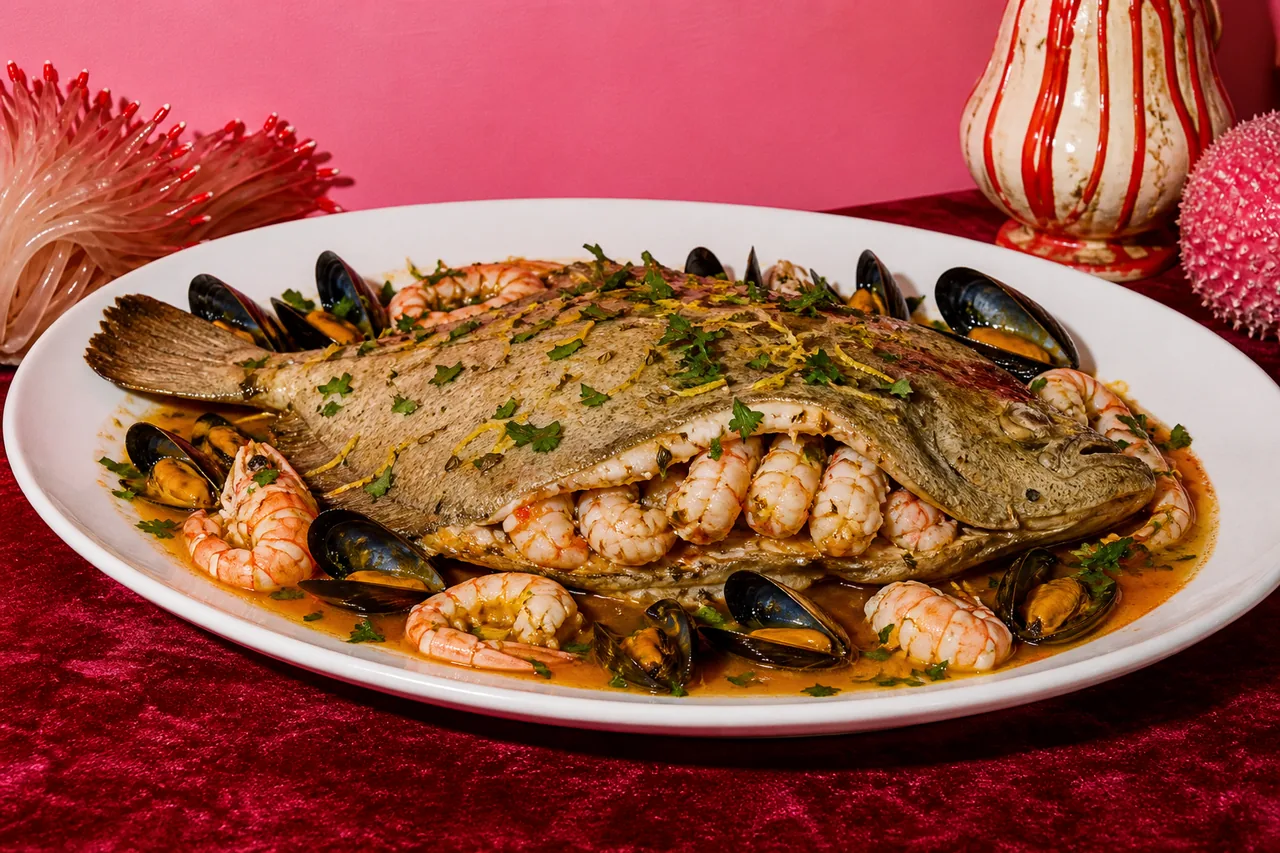
A refined seafood dish showcasing whole flounder: delicate flesh stuffed with langoustines, gently oven-roasted, and paired with a concentrated mussel, fish stock, and cognac jus with a Mediterranean accent.
Ingredients
- 800 g whole portion flounder, gutted and scaled, about 350 to 450 g each
- 180 g raw peeled langoustine tails
- 500 g fresh rope-grown mussels
- 6 cl VS or VSOP cognac
- 300 ml ready-to-use fish stock
- 3 tbsp extra-virgin olive oil
- 2 pieces shallots
- 1 clove fresh garlic
- 1 tsp fennel seeds
- 1 tsp smoked sweet paprika
- 1 pinch ground cayenne pepper
- 80 g thick heavy creme fraiche
- 35 g unsalted butter
- 45 g fresh white breadcrumbs
- 0.5 bunches fresh flat-leaf parsley
- 1 piece unwaxed lemon
- to taste fine salt
- to taste ground white pepper
Method
- Prepare the mussels: rinse them in cold water, remove any visible beards, and discard any that stay open after a firm tap. Keep chilled while prepping.
- Prepare the flounder: pat the fish dry very thoroughly. Using a small, flexible knife, make an incision down the top of each flounder along the central spine, then gently lift the top fillets on each side to create a pocket without piercing the skin underneath. Season the inside very lightly with salt and let rest for 10 minutes in the refrigerator while you make the stuffing.
- Prepare the stuffing: coarsely chop part of the langoustine tails, keeping the prettiest ones whole for finishing. Mix the chopped langoustine with the fresh breadcrumbs, one finely minced shallot, a little parsley, a drizzle of olive oil, lemon zest, salt, and white pepper. The texture should be soft and moist without becoming dense.
- Stuff the flounder: spoon the stuffing into the prepared pockets, then gently fold the top fillets back over to enclose the filling. Lightly oil a baking dish, place the fish white-skin side down, and brush the top with olive oil. Keep cool until ready to bake.
- Open the mussels: heat a large pot over high heat (around 200 °C). Add a drizzle of olive oil, the remaining shallot, and the crushed garlic, then sweat for 1 to 2 minutes without browning. Add the mussels, cover, and cook over high heat for 3 to 4 minutes, shaking the pot regularly, until all shells have opened wide and the juices are bubbling actively.
- Strain the juices: remove the mussels with a slotted spoon and pour the cooking liquid through a fine-mesh sieve lined with cheesecloth. Shell most of the mussels, leaving a few whole in their shells for plating. Discard any mussels that remain closed.
- Start the sauce: in a saute pan over medium heat (around 150 °C), heat a drizzle of olive oil with the fennel seeds for 1 minute until fragrant and crackling. Add the smoked sweet paprika and cayenne pepper, stirring briskly for 30 seconds to toast without burning.
- Deglaze with cognac: remove briefly from the heat, pour in the cognac, then flambé or bring to a vigorous boil over high heat (around 100 °C) for 1 minute until the alcohol vapors dissipate and the liquid reduces by half.
- Reduce the jus: pour in the strained mussel juices and the fish stock. Bring to a gentle simmer (around 90 °C) and reduce uncovered for 12 to 15 minutes, until the liquid is reduced by half and coats the back of a spoon.
- Roast the flounder: bake the fish in an oven preheated to 160 °C (convection) for 15 to 18 minutes, basting halfway through with the pan juices. The flounder is done when the flesh reaches 52 to 54 °C at the center on a digital thermometer and flakes into pearlescent petals. Let rest for 3 minutes out of the oven before serving.
- Finish the sauce: lower the heat under the saute pan to very low (around 80 °C), whisk in the creme fraiche, and simmer gently for 2 minutes. Off the heat, mount the sauce by whisking in the cold diced butter for 1 minute until smooth, emulsified, and glossy. Balance with a splash of lemon juice if needed.
- Cook the reserved langoustines: heat a skillet with a drizzle of olive oil over high heat (around 180 °C). Sear the langoustine tails for 1 minute on the first side until golden, flip, and cook for 30 to 45 seconds on the other side, until the flesh turns opaque and pearly throughout.
- Warm the mussels: slide the shelled mussels into the warm sauce off the heat for 1 minute to warm them through gently without toughening their flesh.
- Plate: place each stuffed flounder in the center of a warm plate. Arrange the seared langoustines and mussels decoratively around the fish, then spoon a neat ribbon of the smoky sauce alongside. Garnish with chopped parsley, lemon zest, and a grind of white pepper.
- Serve immediately: enjoy piping hot with a neutral, sauce-absorbing side such as steamed potatoes or plain white rice.
Nutrition
Per serving
- Energy
- 922.5 kcal
- Protein
- 60.86 g
- Carbohydrate
- 31.43 g
- Fat
- 55.98 g
- Fibre
- 6.17 g
- Calcium
- 52.98 mg
- Iron
- 0.87 mg
- Magnesium
- 16.71 mg