
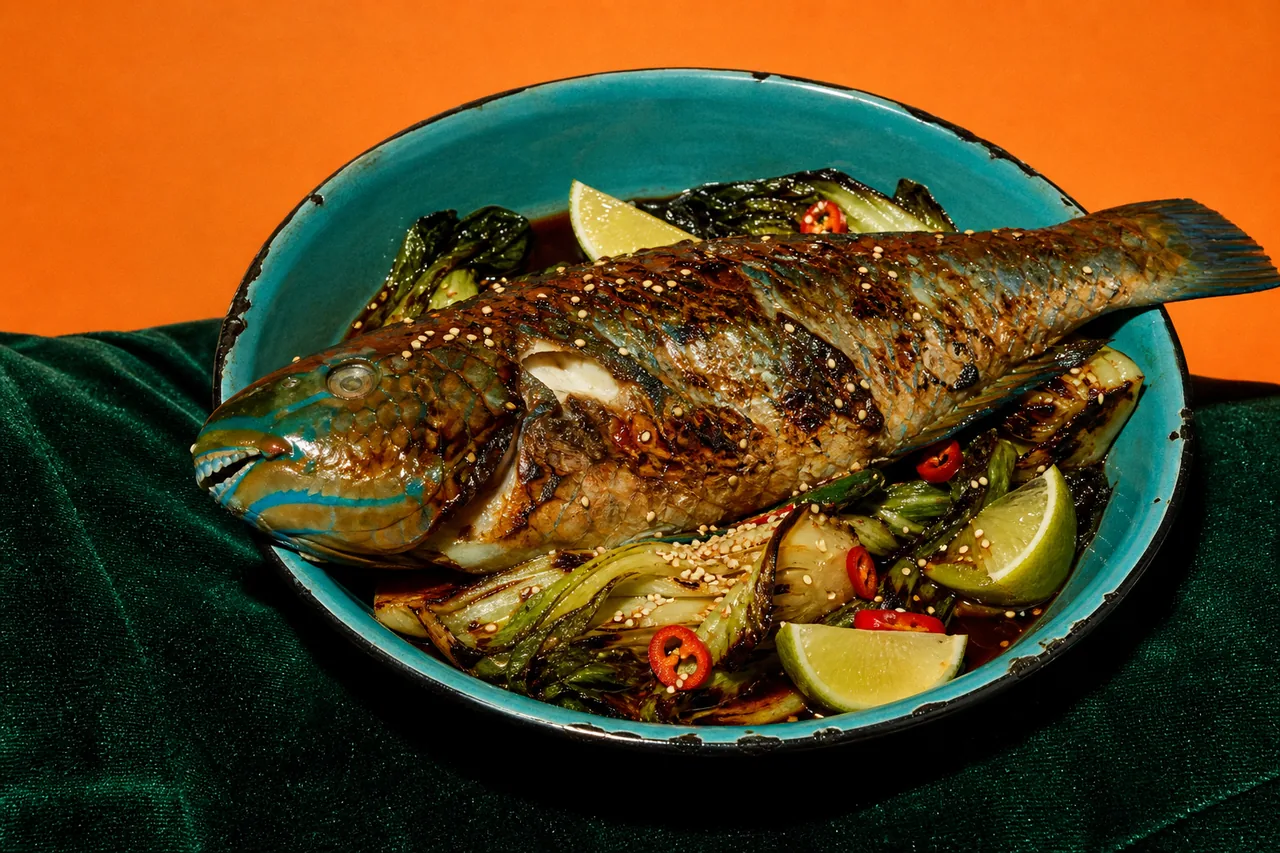
A whole fish gently roasted and finished with a lively soy, lime, and ginger marinade. Pak choi, scallions, and a touch of sesame carry the Asian profile without masking the fish's delicate, firm flesh.
Ingredients
- 900 g whole gutted and scaled blue-banded parrotfish
- 55 ml light soy sauce
- 2 pieces unwaxed limes
- 35 g fresh ginger
- 1 bunch fresh scallions
- 350 g pak choi
- 1 piece fresh mild red chili
- 2 tsp toasted sesame oil
- 1 tbsp rice vinegar
- 2 tbsp Shaoxing wine
- 2 tbsp neutral cooking oil
- 1 tbsp white sesame seeds
- to taste fine salt
Method
- Check the fish: it should smell clean and briny, have a bulging eye, and shiny skin. Rinse it quickly under cold water, dry it very thoroughly with paper towels, then make shallow diagonal cuts in the flesh on both sides, down to the backbone without cutting through it.
- Prepare the marinade: finely grate the ginger, zest the limes, then squeeze their juice. Mix the soy sauce, lime juice and zest, ginger, Shaoxing wine, rice vinegar, sesame oil, and a little finely sliced chili. The marinade should be salty, tangy, and very fragrant, but not syrupy.
- Season the fish with very little salt, especially in the cuts and cavity. Coat it with the marinade, gently massage the skin and interior, then refrigerate for 20 to 30 minutes. Turn it once halfway through the rest; the fish should be fragrant on the surface without becoming opaque like ceviche.
- Preheat the oven to 200 °C on convection. Take the fish out of the refrigerator while the oven heats so it loses its direct chill; this helps the flesh cook evenly.
- Prepare the vegetable base: halve the pak choi lengthwise, keep a few scallions whole for cooking, and thinly slice the rest for finishing. Lightly oil the vegetables, arrange them in an ovenproof dish, then place the fish on top. Set the remaining marinade aside; it must not be poured over raw as a finishing sauce.
- Place the dish in the middle of the oven. Cook until the skin begins to tighten, the scallions brown in spots, and the juices bubble at the bottom of the dish. Baste once with the hot pan juices to glaze the skin.
- During cooking, reduce the remaining marinade in a small saucepan over medium heat. Let it boil vigorously for a few minutes, until it becomes glossy and slightly thickened and the raw smell of the ginger rounds out. If it becomes too salty, thin it with a splash of hot water.
- When the fish is nearly cooked, brush the skin with the reduced marinade. Return it to the oven for a few minutes, just until the glaze sets and becomes satiny. The fish is ready when the flesh flakes off in large petals near the backbone and the juice beading in the cut is clear.
- Let the fish rest out of the oven for 5 minutes. This rest is important: the heat finishes traveling through the central bone and the flesh stays juicy instead of contracting on the plate.
- During the rest, toss the pak choi and scallions in the pan juices to coat them. Add a few drops of fresh lime if the juices seem too rounded; they should remain bright, briny, and clean.
- Serve the whole fish over the vegetables, sprinkle with sliced scallions, sesame seeds, and thin rounds of chili. At the table, lift the fillets along the backbone and spoon a little hot pan juice over each portion without drowning the flesh.
Nutrition
Per serving
- Energy
- 511.1 kcal
- Protein
- 48.66 g
- Carbohydrate
- 14.28 g
- Fat
- 27.19 g
- Fibre
- 6.21 g
- Calcium
- 89.55 mg
- Iron
- 1.29 mg
- Magnesium
- 43.85 mg