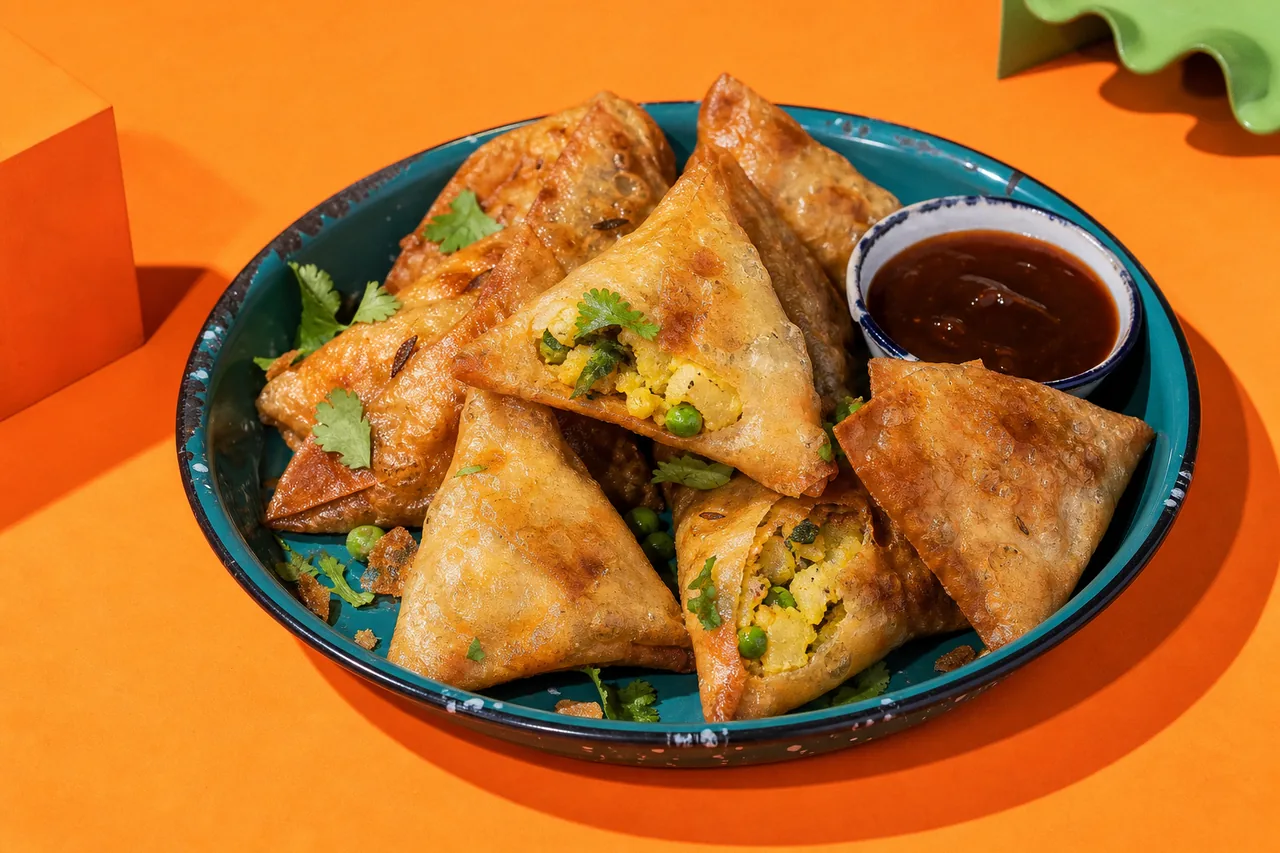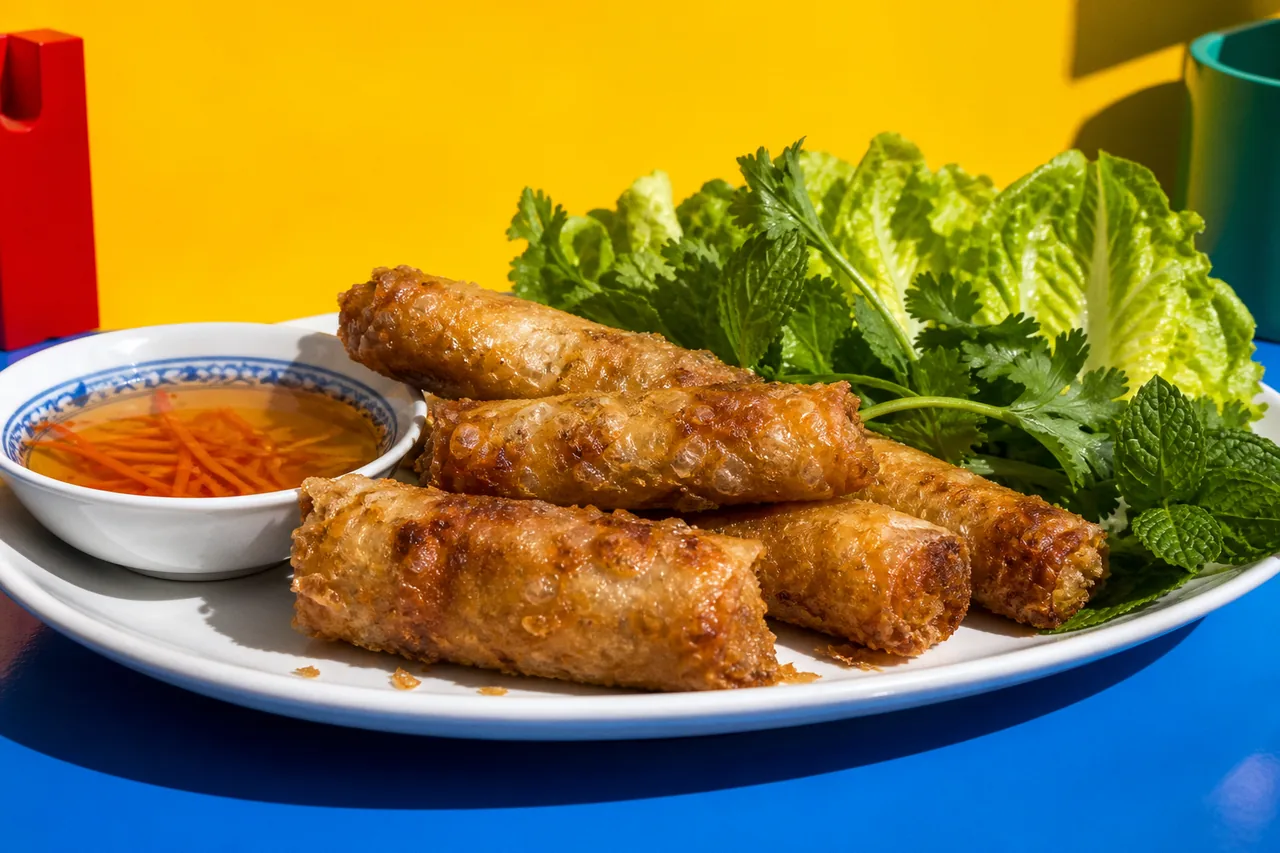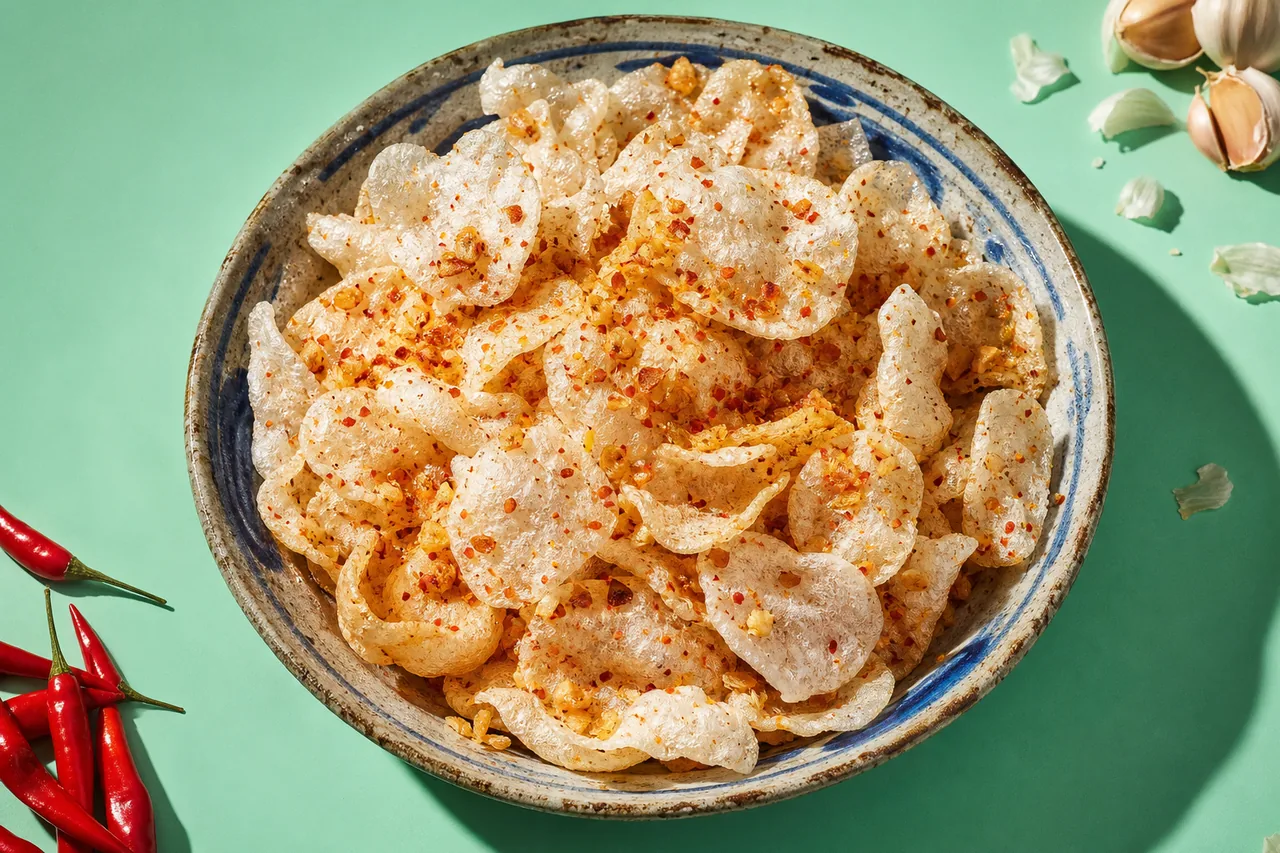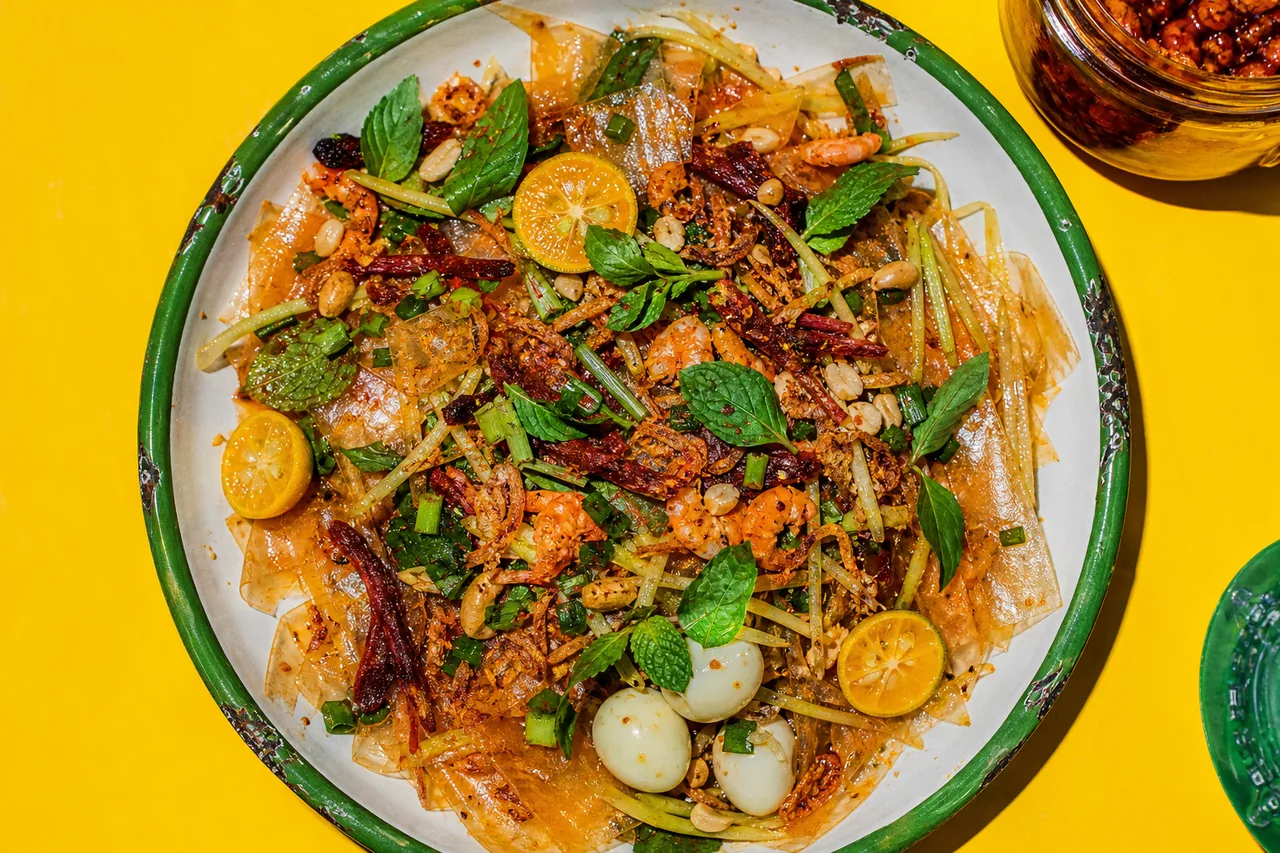
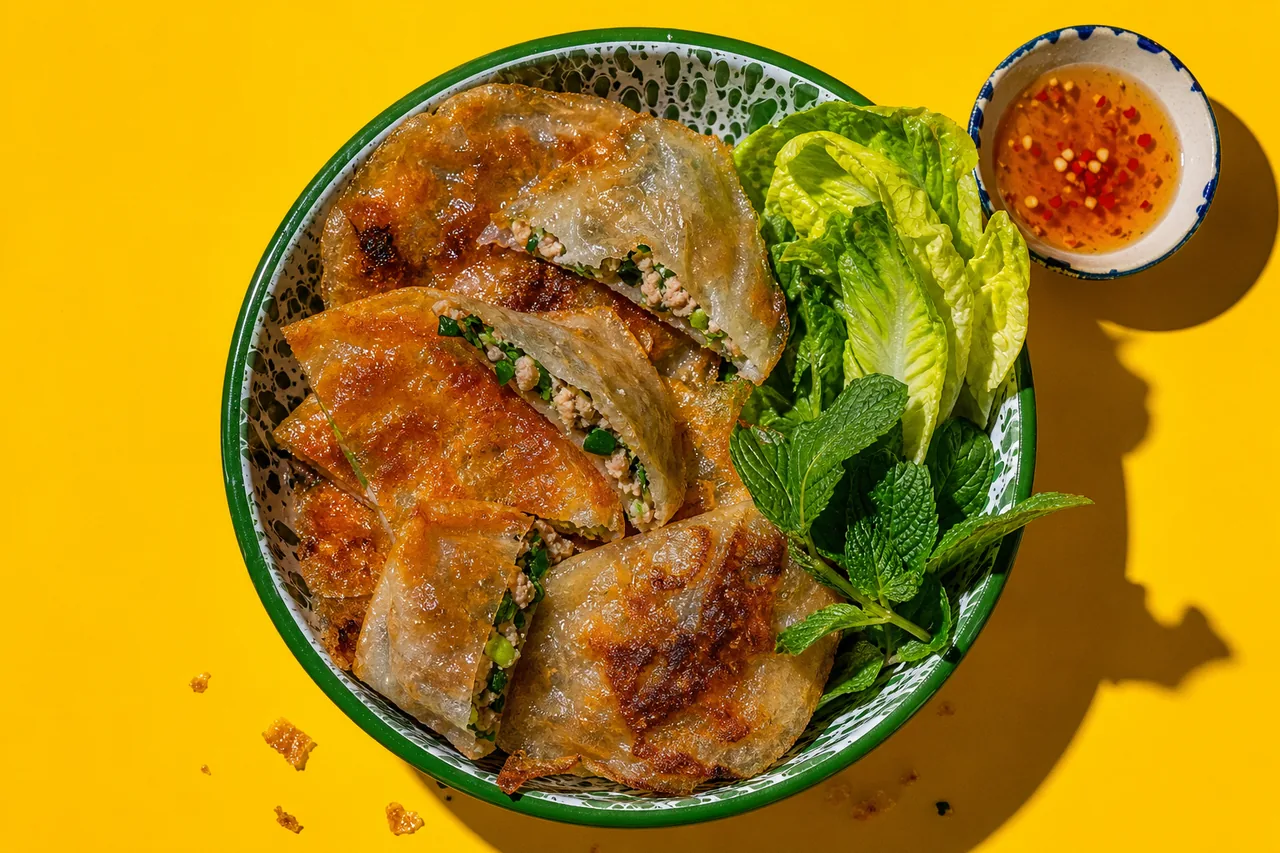
Pork, scallion, and Chinese garlic chive bánh tráng chiên: two sealed rice paper sheets pan-seared until the edges turn shatteringly crisp, leaving a slightly chewy center that never turns doughy or bready.
Ingredients
- 32 sheets round Vietnamese rice paper sheets, about 22 cm
- 650 g ground pork shoulder
- 160 g fresh Chinese garlic chives
- 1 bunch fresh scallions
- 1 piece yellow onion
- 4 cloves fresh garlic
- 45 ml Vietnamese fish sauce
- 15 ml light soy sauce
- 2 tsp light cane sugar
- 1 tsp ground black pepper
- 90 ml neutral cooking oil
- 500 ml lukewarm water to hydrate the wrappers
- 180 ml nước chấm dipping sauce
- 12 leaves romaine lettuce leaves
- 1 bunch fresh mint
Method
- Prepare the filling: finely slice the scallions and Chinese garlic chives, and mince the onion and garlic. Keep the pieces small so the filling spreads in a thin layer and will not puncture the rice paper.
- Heat a large skillet or wok over medium-high heat (about 170 °C) with a drizzle of neutral oil for 1 minute. Add the onion and sweat for 3 to 4 minutes until translucent, glossy, and tender under the spatula, without browning.
- Add the minced garlic and stir briskly for 45 seconds over medium heat until fragrant, making sure it stays pale golden without burning.
- Add the ground pork shoulder. Break it up with the spatula while cooking to create a fine texture. Sear over medium-high heat for 5 to 6 minutes, until the meat loses all pink color and reaches an internal temperature of at least 72 °C.
- Season with the fish sauce, light soy sauce, cane sugar, and black pepper. Continue cooking over medium heat for 3 minutes to reduce: when you drag a spatula across the pan, the cleared path should hold for 2 seconds without any juices running back into it.
- Turn off the heat, then fold in the scallions and Chinese garlic chives for 30 seconds using the residual heat to wilt them while keeping their vibrant green color. Spread the filling onto a wide plate and let cool for 10 minutes (to about 35 °C).
- Set up your assembly station: a wide shallow dish of lukewarm water (about 35 to 40 °C), a lightly dampened cutting board, the rice paper sheets, the cooled filling, and a clean skillet for cooking. Keep a damp towel nearby.
- Dip a sheet of rice paper for 3 to 5 seconds in the lukewarm water, just long enough to make it pliable without letting it become completely limp. Lay it flat on the damp board.
- Spoon a thin, even layer of filling in the center of the sheet, about 5 mm thick, leaving a 2 cm clear border all around the edge.
- Dip a second sheet of rice paper for 3 to 5 seconds in the lukewarm water, place it directly over the top, and smooth out any air bubbles from the center outward. Press the 2 cm border firmly all around to seal the two sheets hermetically.
- Rest the sealed dumpling on a lightly oiled baking sheet for 3 minutes so the starch dries slightly and stabilizes the seal before cooking.
- Heat a nonstick skillet over medium heat (about 160-170 °C) with a thin film of vegetable oil for 2 minutes. The pan is ready as soon as a droplet of water sizzles instantly on contact.
- Place a flat dumpling into the hot skillet. Cook undisturbed for 3 to 4 minutes over medium heat: the underside will turn opaque and taut, beginning to brown with a steady, continuous sizzle.
- Carefully flip with a wide spatula. Cook the second side for 3 to 4 minutes until evenly golden brown, covered with small crispy blisters, and firm under the spatula.
- Transfer and let rest on a wire rack for 1 to 2 minutes to let steam escape and keep the crust crisp.
- Cook the remaining dumplings the same way, in batches of 3 to 4 minutes per side, wiping the skillet between batches to keep pan drippings from burning.
- Serve immediately while the crust is hot and crackly, alongside nước chấm dipping sauce, fresh romaine lettuce leaves, and fresh mint sprigs.
Nutrition
Per serving
- Energy
- 790 kcal
- Protein
- 36.82 g
- Carbohydrate
- 85.74 g
- Fat
- 34.85 g
- Fibre
- 3.98 g
- Calcium
- 43.38 mg
- Iron
- 0.98 mg
- Magnesium
- 25.9 mg