
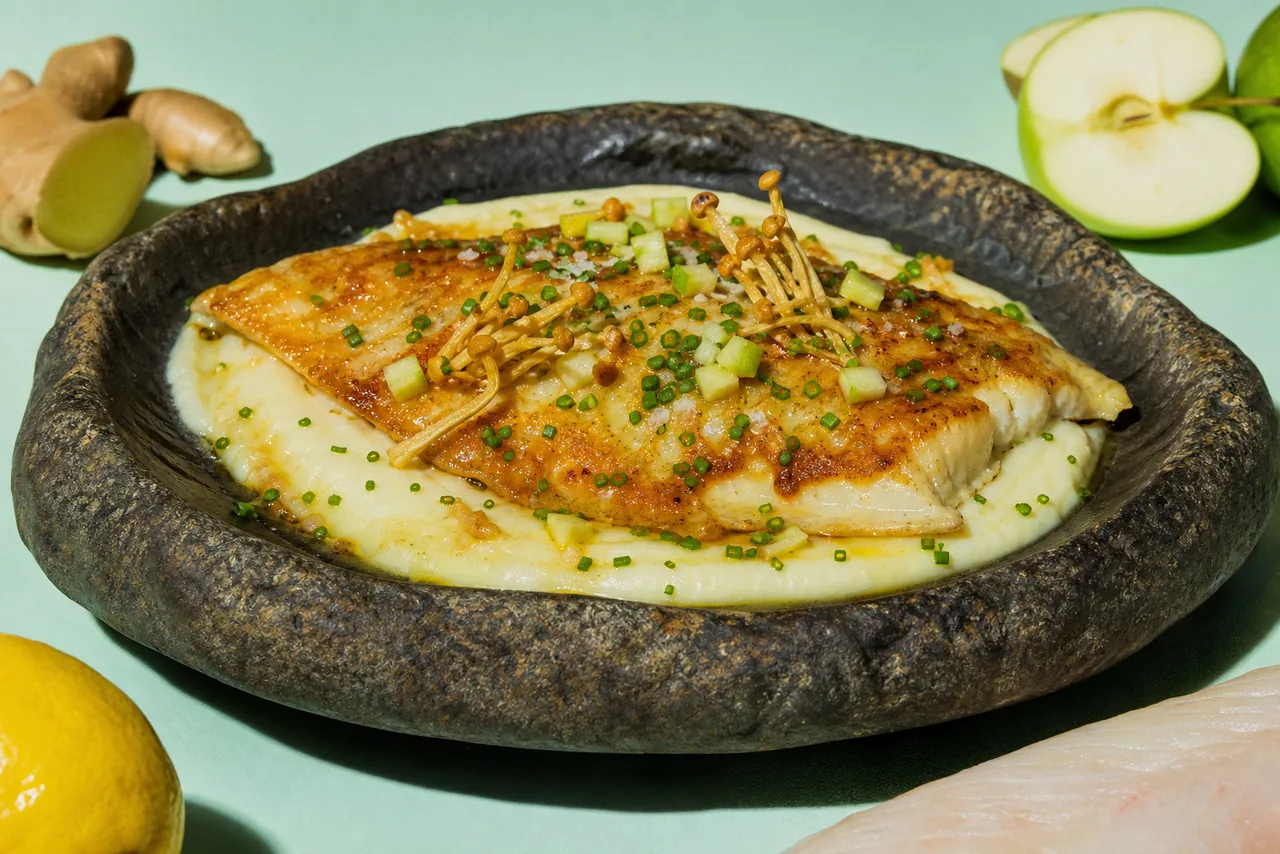
A classic take on sole meunière with pearlescent flesh, lemony brown butter, silky ratte potato mash, crisp diced apple, and crunchy enoki mushrooms to complement the fish's delicate oceanic flavor.
Ingredients
- 360 g fresh sole fillets, skinned and filleted by the fishmonger
- 500 g ratte potatoes
- 1 piece Granny Smith apple
- 130 g high-quality unsalted butter
- 80 ml whole milk
- 80 g fresh enoki mushrooms
- 40 g all-purpose flour
- 1 piece unwaxed lemon
- 0.25 bunches fresh chives
- 10 g fresh ginger
- to taste fleur de sel
- to taste fine salt
- to taste ground white pepper
Method
- Remove the sole fillets from the refrigerator, pat dry thoroughly with paper towels, and let rest at room temperature for 20 minutes to temper the flesh. The surface must feel completely dry to the touch to ensure a crisp, delicate meunière crust rather than a pasty one.
- Place the unpeeled, whole ratte potatoes in a pot of cold, well-salted water. Bring to a boil, then lower the heat to medium to maintain a steady simmer at 95 °C for 20 to 25 minutes, until a knife tip slides in without any resistance. Drain, let the steam escape for 2 minutes, then peel while hot.
- Pass the potatoes through a food mill or potato ricer. In a small saucepan over low heat, warm the milk with a portion of the butter for 3 minutes until it reaches about 70 °C (steaming gently without boiling), then gradually fold it into the puree. Work with a spatula for 1 minute until smooth and glossy. Season with fine salt and white pepper, then keep warm over very low heat (60 °C).
- Prepare the garnish: cut the apple into a 2 mm brunoise and finely grate the ginger. Toss immediately with a squeeze of lemon juice, add a pinch of fleur de sel, and mix well to keep the apple crisp and prevent browning.
- Trim the enoki mushrooms by cutting off 2 cm of the root base, then separate into small clusters. Saute in a hot skillet over high heat with a knob of butter for 2 minutes to 2 minutes 30, until the stems soften and the tips turn golden and crisp. Season lightly with salt and remove from the heat.
- Season the sole fillets with fine salt and white pepper on both sides. Dredge in flour, then tap each fillet firmly to shake off all excess: only a sheer, translucent dusting should coat the flesh.
- Heat a large skillet over medium-high heat with a portion of the butter to about 160 °C. As soon as the foam subsides and sizzles without browning, gently lay the fillets in the pan. Cook undisturbed for 2 minutes, until the edges turn opaque and the underside is evenly golden brown.
- Gently flip the fillets with a wide spatula and cook the second side for 1 minute to 1 minute 30, until the center reaches 52 °C (opaque on the outside, but still pearlescent at the core). Transfer immediately to a warm plate and let rest for 1 to 2 minutes.
- Quickly wipe out the skillet with paper towels if needed. Add the remaining butter and melt over medium heat for 2 to 3 minutes: the butter will foam, hiss, and then quiet down as the milk solids turn amber (around 130 °C to 140 °C) and release a fragrant toasted hazelnut aroma. Remove from the heat and immediately pour in the lemon juice to halt the cooking with a lively sizzle.
- Return the fillets to the pan off the heat for 30 seconds, spooning the lemony brown butter continuously over the fish to glaze and warm it without letting the core exceed 55 °C.
- Plate immediately on prewarmed plates: spoon a generous dollop of warm ratte potato puree, set a pearlescent sole fillet alongside, spoon over the brown butter, scatter the golden enokis, and finish with the tart apple brunoise and minced chives.
- Sprinkle with a pinch of fleur de sel and serve right away.
Nutrition
Per serving
- Energy
- 930.5 kcal
- Protein
- 42.21 g
- Carbohydrate
- 66.86 g
- Fat
- 57.72 g
- Fibre
- 10.16 g
- Calcium
- 94.55 mg
- Iron
- 1.97 mg
- Magnesium
- 21.55 mg