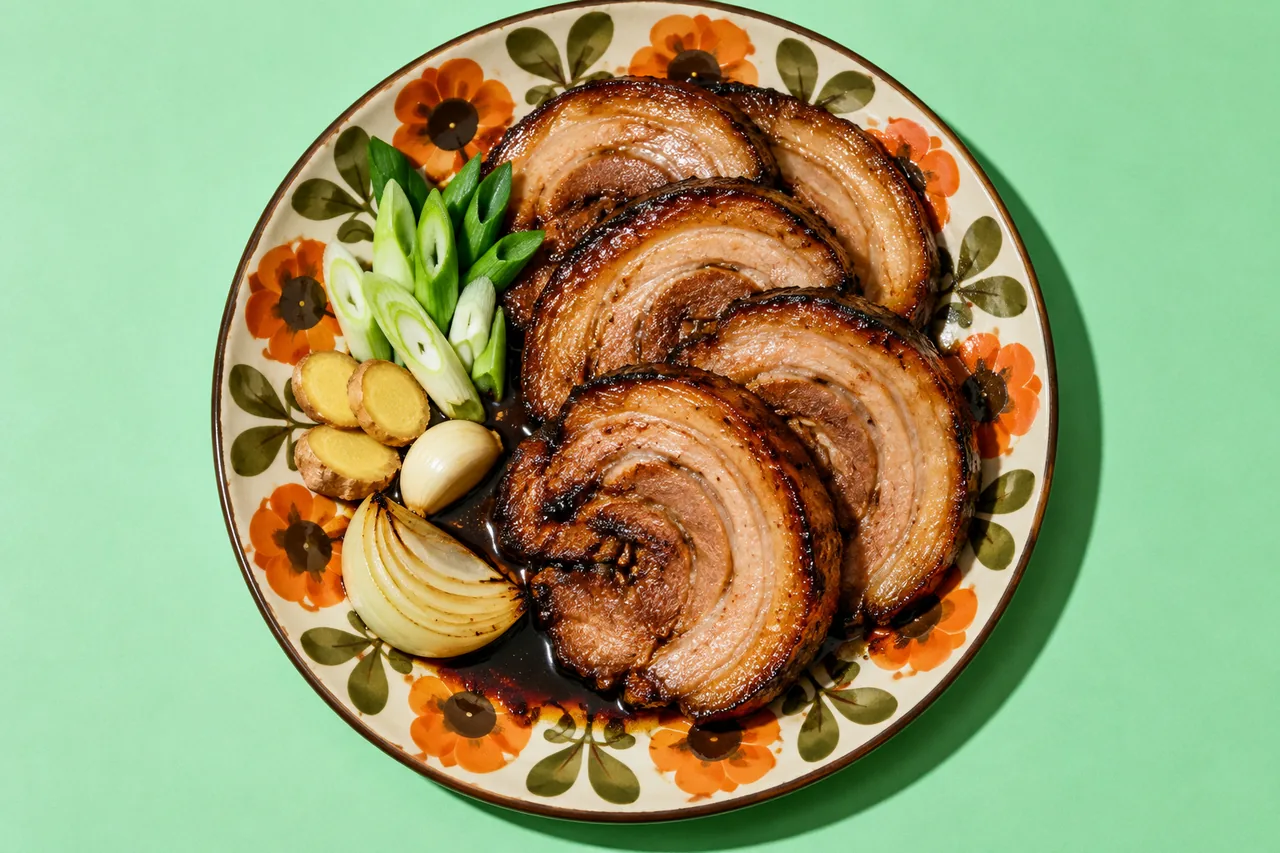
This traditional chashu showcases whole pork belly, rolled tightly and gently braised in an aromatic broth seasoned with shoyu, sake, and fresh aromatics. The texture turns meltingly tender, with silky skin and concentrated pan juices infusing every bite.
Ingredients
- 1200 g skin-on pork belly
- 300 ml Japanese koikuchi soy sauce
- 150 ml Japanese cooking sake (ryorishu)
- 150 ml authentic Japanese mirin (hon-mirin)
- 600 ml filtered water
- 60 g granulated white sugar
- 5 cloves cloves white garlic
- 30 g fresh ginger root
- 2 pieces fresh scallions (negi)
- 1 piece fresh yellow onion
- 1 tbsp refined standard sunflower oil
Method
- Lay the skin-on pork belly flat on your work surface, skin side down.
- Roll the meat tightly lengthwise to form a firm, even cylinder.
- Tie the pork roll securely with butcher's twine, spacing loops about 2 centimeters (3/4 inch) apart, then knot both ends firmly to keep the roll compact throughout cooking.
- Heat the refined sunflower oil over high heat in a Dutch oven until it reaches about 180 °C (350 °F), just when it begins to smoke lightly.
- Add the tied pork roll and sear over medium-high heat for 8 to 10 minutes, turning regularly, until the entire surface is evenly golden brown and crackling vigorously.
- Smash the white garlic cloves with the flat side of a knife blade without peeling them, cut the fresh yellow onion in half, and slice the fresh ginger root into thick coins about 5 mm (1/4 inch) thick. Roughly chop the fresh scallions.
- Temporarily remove the pork from the Dutch oven, discard the excess rendered fat from the bottom to keep the broth clean, and return the roll to the pot.
- Add the fresh yellow onion, white garlic cloves, fresh ginger, and fresh scallions around the meat.
- Pour the Japanese koikuchi soy sauce, authentic Japanese mirin, Japanese cooking sake, granulated white sugar, and filtered water into the Dutch oven.
- Bring to a gentle boil over medium heat for 6 to 8 minutes, reaching around 95 °C (200 °F), skimming off any gray foam that rises to the surface during the initial boil.
- Reduce the heat to very low to maintain a gentle simmer between 85 °C and 90 °C (185 °F to 195 °F), then place a parchment paper round with a small vent hole in the center directly on the liquid to act as an otoshi-buta drop lid.
- Cover with the lid slightly ajar and simmer gently at 85 °C to 90 °C (185 °F to 195 °F) for 1 hour and 45 minutes, turning the cylinder every 30 minutes, until a wooden skewer pierces through the center with no resistance and the internal temperature reaches at least 88 °C (190 °F).
- Turn off the heat and let the pork rest directly in its warm broth for 45 minutes off the heat so the meat absorbs the juices and slowly cools.
- Transfer the Dutch oven to the refrigerator at 4 °C (40 °F) for at least 8 hours or overnight to fully set the collagen and surface fats.
- The next day, scrape off the solidified layer of white fat from the surface, lift out the chilled pork roll, and carefully cut away the butcher's twine.
- Slice the cold pork using a very sharp, thin knife into neat rounds 3 to 4 mm (1/8 inch) thick that hold their spiral shape.
- Gently reheat the slices for 1 to 2 minutes in a ladle of hot braising broth at 80 °C (175 °F), or char them with a kitchen blowtorch for 20 to 30 seconds per slice until the edges caramelize and crackle lightly.
Nutrition
Per serving
- Energy
- 461.1 kcal
- Protein
- 37.49 g
- Carbohydrate
- 6.42 g
- Fat
- 30.67 g
- Fibre
- 0.81 g
- Calcium
- 21.05 mg
- Iron
- 1.26 mg
- Magnesium
- 42.72 mg