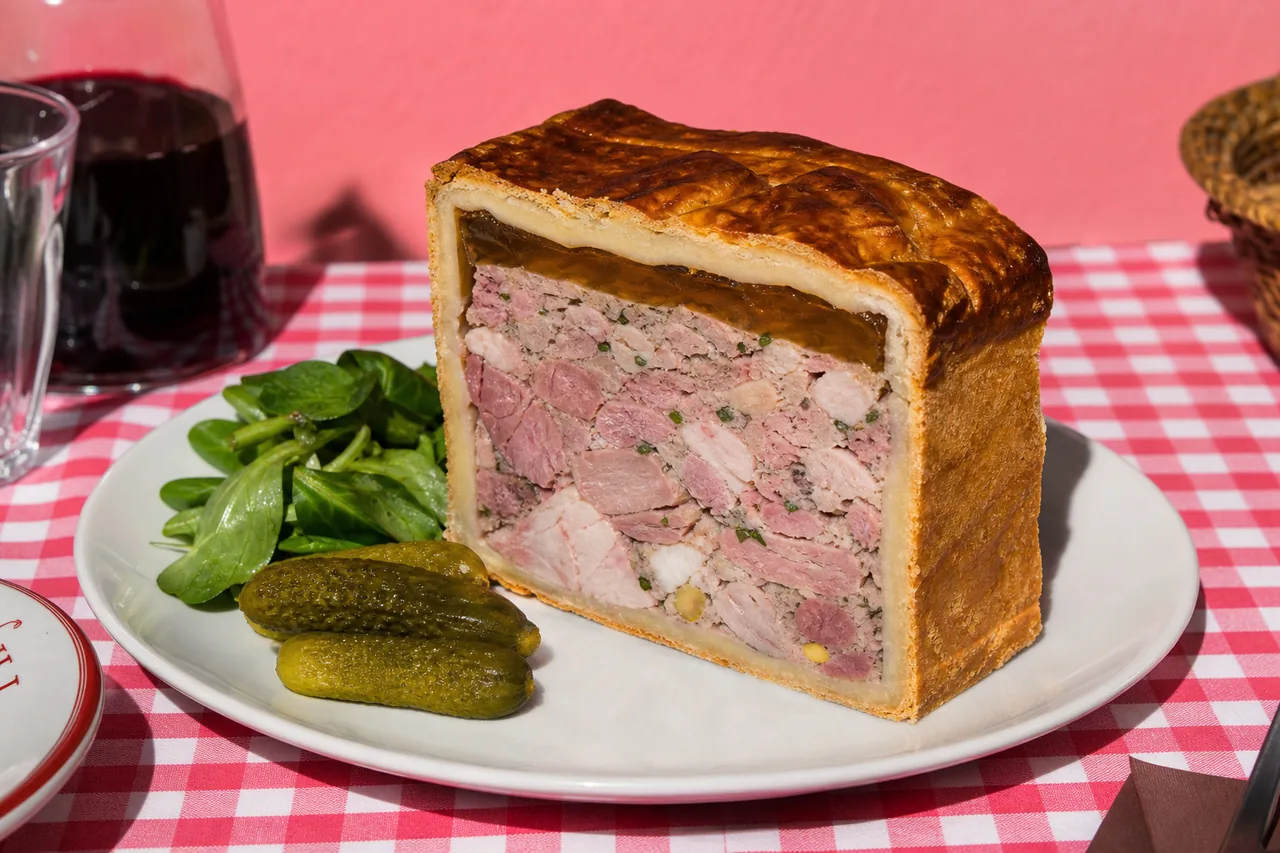
A great classic of French culinary charcuterie: a marinated pork and veal filling, encased in a rich and crispy shortcrust pastry, then finished cold with a Madeira jelly.
Ingredients
- 500 g boneless pork shoulder
- 300 g boneless veal shoulder
- 250 g fresh boneless pork belly
- 2 pieces shallot
- 1 clove fresh garlic
- 6 sprigs fresh flat-leaf parsley
- 80 ml dry white wine
- 30 ml cognac
- 18 g fine salt
- 3 g ground black pepper
- 1 tsp ground quatre-épices
- 500 g T55 wheat flour
- 220 g unsalted butter
- 80 g lard
- 3 pieces fresh egg
- 100 ml cold water
- 300 ml Madeira jelly for charcuterie
Method
- The day before, carefully trim the meats, removing any sinew, cartilage, and bloody parts. Cut about one-third of the pork shoulder and veal into small, even dice. Pass the remaining meats through a meat grinder fitted with a medium plate. If you do not have a grinder, cut them very finely with a knife without reducing them to a purée.
- Combine all the meats in a bowl. Add the finely chopped shallots, garlic, and parsley, then the white wine, cognac, salt, pepper, and quatre-épices. Mix thoroughly by hand until the filling becomes homogeneous and slightly sticky. Cover and let marinate overnight in the refrigerator.
- For the pastry, mix the flour with a small portion of the fine salt. Rub in the cold butter and lard with your fingertips until you achieve a coarse crumb texture. Add the eggs intended for the pastry, then the cold water gradually. Fraiser (smear) briefly on the work surface, without over-kneading, until you obtain a homogeneous and firm dough. Flatten it, cover it, and let it rest in the refrigerator.
- Very lightly butter a rectangular terrine mold or a springform pâté en croûte mold. Reserve about one-quarter of the dough for the lid and decorations. Roll out the rest into a rectangle large enough to line the bottom and sides, letting the pastry overhang the edges.
- Line the mold without stretching the pastry. Press it carefully into the corners to avoid air pockets. Immediately repair any cracks with a small piece of moistened dough.
- Rework the cold filling for a few moments. Cook a small piece in a skillet, taste it, and adjust the seasoning if necessary. Fill the mold in layers, packing firmly with the back of your hand to expel any air. Form a slight dome in the center.
- Roll out the reserved dough and place it over the filling. Moisten the edges, firmly crimp the lid with the overhanging pastry, then trim the excess. Fold over and flute the seal. Pierce two widely spaced steam vents and keep them open with small cylinders of parchment paper or aluminum foil.
- Modestly decorate the lid with the pastry scraps. Beat the reserved egg for the egg wash and apply a first coat with a brush without letting it run into the vents. Refrigerate the pâté until the pastry is firm, then apply a second coat of egg wash.
- Bake in an oven preheated to two hundred degrees Celsius. When the crust is well seared and begins to color, lower the temperature to one hundred and sixty degrees Celsius and continue baking. Protect the top with a sheet of parchment paper if it browns too quickly.
- Check the doneness with a thermometer inserted through a vent: the center of the filling should reach about sixty-eight degrees Celsius. Remove the pâté from the oven at this point and let it cool completely in its mold, without removing the foil vents.
- Prepare or warm the Madeira jelly according to the prepared component instructions. When it is fluid but not hot, slowly pour it through the vents using a small funnel. Proceed in several stages, waiting for the jelly to flow into the spaces around the filling before adding more.
- Refrigerate the pâté in its mold overnight so the jelly sets and the flavors meld. Carefully unmold, then slice with a sharp serrated knife into thick slices. Serve cold, but not ice-cold.
Nutrition
Per serving
- Energy
- 1124.3 kcal
- Protein
- 45.09 g
- Carbohydrate
- 69.47 g
- Fat
- 65.28 g
- Fibre
- 3.06 g
- Calcium
- 48.39 mg
- Iron
- 2.18 mg
- Magnesium
- 47.35 mg