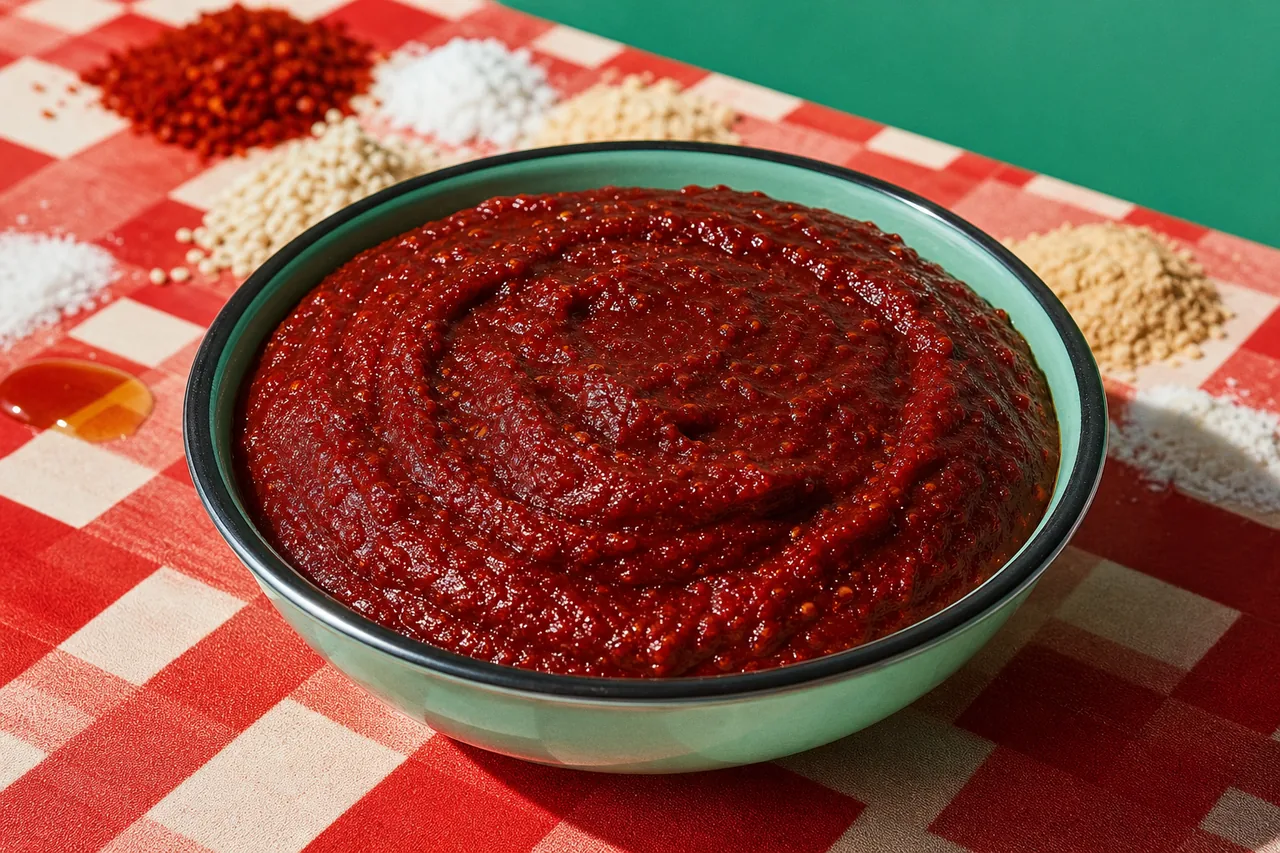
A traditional Korean condiment, thick, deep red, and fermented, made with Korean red chili, fermented soy, glutinous rice, malt, and salt.
Ingredients
- 180 g ground Korean red chili gochugaru
- 120 g glutinous rice flour
- 90 g Korean meju powder
- 80 g Korean barley malt powder
- 35 g wheat germ
- 85 g fine non-iodized sea salt
- 140 g Korean rice syrup
- 900 ml filtered water
Method
- Sterilize a glass jar or small stoneware crock with boiling water, then let it air-dry completely. The container must be clean, dry, and odor-free.
- Prepare the malt infusion by mixing the barley malt powder with the lukewarm filtered water. Let it rest until the liquid takes on the color of weak tea and a mild cereal aroma.
- Strain the infusion through a fine cloth, pressing gently. The liquid should be smooth, without a thick floury deposit, as coarse particles would make a rough paste.
- Pour the strained infusion into a heavy-based saucepan and add the glutinous rice flour. Whisk off the heat until no lumps remain.
- Cook over low heat, stirring constantly with a spatula. The mixture should thicken slowly, become glossy, and form a heavy cream that leaves a clean trail on the bottom of the saucepan.
- Continue cooking gently until the raw flour smell disappears and the base has the texture of a sticky porridge. It must not stick, brown, or boil vigorously.
- Remove from the heat and let it cool until lukewarm. The base should be warm but bearable to the touch, so it does not damage the chili aromas or the qualities of the fermented soy.
- Stir in the rice syrup, then the fine sea salt. Mix until the salt has completely dissolved and the base is homogeneous again.
- Add the meju powder and wheat germ. Mix thoroughly, scraping the sides, until you have a thick, even beige paste with no dry pockets.
- Gradually add the gochugaru. Work the paste with a sturdy spatula until it becomes deep red, dense, satiny, and thick enough to hold its shape on the spatula.
- Transfer to the sterilized jar, pressing it down to remove air pockets. Smooth the surface with a clean spatula, then cover it with a thin layer of salt taken from the surface of the paste if it seems exposed.
- Close with a non-airtight lid or cover with clean cheesecloth secured with a tie. The gochujang must breathe during fermentation while remaining protected from dust.
- Leave to ferment in a cool, airy, bright place away from excessive direct heat. Stir with a perfectly clean spoon at regular intervals at first, then let it mature until the paste smells of fruity chili, fermented soy, and malt, without any harsh odor.
- When the flavor is rounded, salty, hot, and slightly sweet, close the jar properly and store it in a cool place. Serve in small amounts as a condiment, sauce base, stew seasoning, or marinade.
Nutrition
Per serving
- Energy
- 576.4 kcal
- Protein
- 22.53 g
- Carbohydrate
- 99.13 g
- Fat
- 13.31 g
- Fibre
- 17.88 g
- Calcium
- 17.5 mg
- Iron
- 1.52 mg
- Magnesium
- 75.73 mg